Press Release regarding the Ownership of the yacht Dilbar by THE SISTER TRUST

| Name: | Dilbar |
| Length: | 156 m (511 ft) |
| Builder: | Lurssen |
| Year: | 2016 |
| Owner: | The Sister Trust, established by Alisher Usmanov |


| Name: | Dilbar |
| Length: | 156 m (511 ft) |
| Builder: | Lurssen |
| Year: | 2016 |
| Owner: | The Sister Trust, established by Alisher Usmanov |
Frankfurt Court Confirms: Alisher Usmanov Does Not Own or Control the Dilbar Yacht
June 29, 2026
Alisher Usmanov welcomes the ruling made by the Frankfurt am Main Administrative Court on June 11, 2026 in favor of the Lürssen shipyard in the lawsuit against the Federal Office for Economic Affairs and Export Control (BAFA). This ruling debunks libelous claims about “hidden control” and trust arrangements being used by Alisher Usmanov to conceal his assets. Alisher Usmanov also appreciates the firm and consistent stance taken by the Lürssen shipyard.
The court ruling eliminates any legal uncertainty in the matter of ownership of the Dilbar yacht and debunks the false narrative promoted in the media since 2022 that involves allegations of “hidden control” and “complex” trust arrangements being used by Alisher Usmanov to conceal assets.
As is well known, in 2016, Alisher Usmanov established an irrevocable trust, known as The Sister Trust, which was entrusted with assets that are especially valuable to the family (such as the Dilbar yacht and the Burkhan aircraft), for estate planning purposes. The trust has been established and operates in full compliance with applicable law and is managed by an independent professional trustee. Neither Alisher Usmanov nor his sister Gulbakhor Ismailova has any title to the assets held by the trust or receives any benefits from it.
False statements made by the media about the Dilbar yacht being owned and controlled by Alisher Usmanov and Gulbakhor Ismailova have been repeatedly refuted by German courts, which have issued six court orders, and the media outlets themselves, which have signed 55 cease-and-desist declarations and have voluntarily deleted or corrected hundreds of articles.
Sadly, Germany’s law enforcement agencies have wasted more than four years on a fruitless search for non-existent evidence of “ownership” and “control” as part of several simultaneous investigations targeting Alisher Usmanov, most of which have been closed without filing an indictment and maintaining the presumption of innocence.
The ruling of the Frankfurt am Main Administrative Court closes the book on the matter.
For reference. According to the ruling by the Frankfurt am Main Administrative Court, in April 2025, the Lürssen shipyard, which houses the Dilbar yacht, requested that BAFA confirm that the yacht should not be considered as a frozen asset within the meaning of the EU sanctions regulations. Following BAFA’s refusal and an unsuccessful administrative appeal, Lürssen brought the matter to court. In June 2026, the Frankfurt am Main Administrative Court ruled that BAFA’s refusal was unlawful. The court ordered BAFA to determine that Lürssen is not required to treat the vessel as a frozen economic resource as there are no grounds for recognizing the vessel as an asset owned or controlled by persons included in the EU sanctions list.
Alisher Usmanov’s press office, [email protected]
We use AI to translate this text. This is the original text: https://www.rv.hessenrecht.hessen.de/bshe/document/LARE260000772
Translate text:
Court: Administrative Court Frankfurt, 5th Chamber
Decision date: 11 June 2026
Case number: 5 K 4570/25.F
ECLI: ECLI:DE:VGFFM:2026:0611.5K4570.25.F.00
Document type: Judgment
Source: Hesse
Legal provisions: Article 2 Regulation (EU) No. 269/2014; Section 42(1) VwGO; Section 43 VwGO; Section 8(2), sentence 2 AWG; Section 13(1) AWG, etc.
On the distinction between BAFA and the ZfS in the EU sanctions regime
The defendant is ordered, with the rejection notice of the Federal Office for Economic Affairs and Export Control dated 26 September 2025, in the form of the objection decision dated 8 December 2025, being set aside, to issue the administrative act requested by the claimant on 21 July 2025 and to determine that the claimant is not obliged to freeze the vessel M/Y … pursuant to Article 2(1) of Regulation (EU) No. 269/2014, i.e. to treat it as a frozen economic resource.
The defendant shall bear the costs of the proceedings. The costs of the preliminary proceedings are declared reimbursable.
The judgment is provisionally enforceable as to costs against security in the amount of 110 percent of the amount enforceable on the basis of the judgment.
The appeal is admitted.
The parties are in dispute as to whether the vessel M/Y … must be frozen pursuant to Article 2(1) of Regulation (EU) No. 269/2014. The claimant is a traditional German shipyard and is active in civilian shipbuilding, including worldwide in the luxury yacht segment.
The claimant and the defendant’s authorities have been in correspondence concerning the M/Y … since 3 March 2022. This vessel was built by the claimant. At the time, it was the largest vessel the claimant had built. In the luxury yacht sector it is customary for vessels to be overhauled and refitted from time to time, known as a refit. In 2021, the M/Y … was handed over to the claimant for the purpose of carrying out a comprehensive refit. For this purpose, the claimant and A-Ltd. entered into a refit contract on 6 September 2021 for the performance of shipbuilding work on the yacht M/Y …. Under clause 13.1, the contract is governed by English law.
The owner of the M/Y … is A-Ltd. This is undisputedly apparent from the Cayman Islands Shipping Register, where the vessel was registered under number …. According to the information available to the claimant, the shareholder of A-Ltd. is B-Ltd., having its registered office in Cyprus, registration number …. All shares in this holding company are held by C-SA as trustee for the benefit of the “D-Trust”. C-SA has its registered office in P-City, Switzerland.
Until 19 December 2017, Mr X was the beneficiary of the “D-Trust”. After his departure, according to a letter from …, Director of C-SA, his sister, Ms Y, became the beneficiary of the “D-Trust”. Mr X has been listed in the European Union pursuant to Article 2(1) of Regulation (EU) No. 269/2014 in conjunction with Annex I, number …, since 28 February 2022. Ms Y was also listed from 8 April 2022 until 14 March 2025 pursuant to Article 2(1) of Regulation (EU) No. 269/2014 in conjunction with Annex I, number …. In the then entry, she was described in the “Reasons” column as the “sole beneficial owner” of the M/Y …. Ms Y was removed from Annex I to Regulation (EU) No. 269/2014 by Implementing Regulation (EU) 2025/527.
Most recently, the claimant had applied for an administrative act determining that the vessel was not to be frozen by it, i.e. was not to be treated as a frozen economic resource.
The claimant takes the view that, on the basis of the statutes of the “D-Trust” as set out in the judgment of the General Court of the European Union, First Chamber, of 8 May 2025, T-234/22, Frau Y automatically ceased to be a beneficiary of the “D-Trust” as a result of her listing on 8 April 2022, because sanctioned persons could not be beneficiaries of the trust.
The claimant refers to the following French original wording and its German translation:
“Clause 141: The second exclusion clause produced in Annex A.17 to the application provides that any ‘designated person’ is excluded from the ‘D-Trust’, namely any person subject, in particular, ‘to sanctions under Regulation … No. 269/2014 or any other provision issued by the Council having similar effect’. This exclusion is temporary in nature, since that exclusion clause provides that such a person is excluded for as long as he or she remains a ‘designated person’.”
According to the claimant, Mr X had only been permitted to use the vessel by way of rental after his departure as beneficiary of the trust in 2017. It must be assumed that the Council of the European Union removed Ms Y from Annex I to Regulation (EU) No. 269/2014 in the knowledge of this case law. The Council therefore appears to assume that Ms Y no longer has a close relationship with Mr X that would justify her listing under Article 3(1)(g) of Regulation (EU) No. 269/2014, even though, after being removed from the sanctions list, she could again be considered as beneficiary of the “D-Trust”. Whether she has in fact again become beneficiary of the trust or has waived that right cannot be verified by the claimant.
For the routine custody of the yacht, taking account of an advance payment, the claimant has outstanding claims until the end of 2025 in the net amount of …, or … euros gross, which have not yet been settled by A-Ltd. However, the claimant initially considered itself prevented from issuing invoices to A-Ltd. In a letter dated 22 May 2024, the Public Prosecutor’s Office … expressly stated that accepting payments from A-Ltd. on the basis of the invoices submitted might require an exemption authorisation from the Deutsche Bundesbank.
For that reason, by letter of 2 August 2024, the claimant applied to the Deutsche Bundesbank for a determination that no authorisation was required before receiving payments from A-Ltd. The Bundesbank replied by email dated 9 August 2024 that the claimant was not obliged to submit an application, but then stated in an email dated 17 March 2025 that it would not make the determination, since “the list entry of Y has meanwhile been deleted by Council Implementing Regulation (EU) 2025/527 of 14 March 2025 implementing Regulation (EU) No. 269/2014”. As a result, preliminary investigation proceedings conducted against the claimant by the Public Prosecutor’s Office … were discontinued.
By application dated 21 July 2025, submitted via ELAN-K2, the claimant applied to BAFA for a determination that the claimant was not obliged to freeze the vessel M/Y … pursuant to Article 2(1) of Regulation 269/2014. The procedure was conducted under application number DE / ….
In response to a request for information from the Central Office for Sanctions Enforcement (ZfS), the claimant stated by letter dated 18 August 2025, concerning its planned further action, that it had a pending matter before BAFA in which it was to be determined whether the M/Y “…” was to be treated as a frozen economic resource or not.
By email and letter dated 4 August 2025, BAFA replied to this application letter and stated that it lacked subject-matter jurisdiction. The contrary view of the Administrative Court Frankfurt am Main in case 5 L 1517/24.F, by order of 9 August 2024, was not final. In addition, a freezing obligation already resulted from the wording of the regulation. No instructions on legal remedies were attached to that letter.
On 17 September 2025, the claimant brought an action before the Administrative Court Frankfurt am Main, initially seeking an order requiring the defendant to issue the administrative act applied for on 21 July 2025 and, in the alternative, a declaration that the claimant was not obliged to treat the vessel M/Y … as a frozen economic resource.
In support of its claim, the claimant argued that its action was admissible under Section 75 VwGO, since BAFA’s letter of 4 August 2025 indicated that the matter was considered closed there. The failure to issue a decision violated the claimant’s own rights, because it could not freely operate the part of its shipyard where the vessel was located; the vessel blocked …. The claimant was faced with a conflict of duties: if it froze the vessel without justification, it would breach the statutory obligation to return property belonging to another and would also act in breach of contract; if it handed the vessel over to the shipowner even though it still had to be frozen, it would expose itself to the risk of criminal investigation for disposing of a frozen economic resource, a risk which, as the statements of the Public Prosecutor’s Office … and the ZfS showed, was not merely theoretical.
The claimant could not rely on Article 10 of Regulation (EU) No. 269/2014, since it was not convinced that it was obliged to freeze the vessel. The claimant had a claim against the defendant for the requested determination that the M/Y … was not to be treated as a frozen economic resource, following directly from Articles 2 and 16(1) of Regulation (EU) No. 269/2014. The European Commission also proceeded on that basis, for example in the Commission Opinion of 19 June 2020, C(2020) 4117 final:
“In light of the foregoing, if the designated person is determined to have control over the Entity, the Commission takes the view that the assets of the Entity must be frozen. The Entity may obtain the lifting of the freeze on some or all of its assets by showing that they are in fact not ‘controlled’ by the designated person. The way to do so depends on national procedures. NCAs should make the conclusions regarding the existence of such control public.”
BAFA alone had subject-matter jurisdiction for the requested determination, as followed from the court’s order of 9 August 2024, 5 L 1517/24.F, because the issue concerned the question of whether the prohibitions in Article 2 of Regulation (EU) No. 269/2014 applied at all. Jurisdiction to make determinations concerning whether the prohibitions in Article 2 of Regulation (EU) No. 269/2014 applied followed, among other things, from the fact that BAFA was responsible for authorisations under Articles 4 et seq. of Regulation (EU) No. 269/2014 and, in the context of such authorisation procedures, necessarily had to examine as a preliminary question whether an economic resource was to be frozen. Consequently, BAFA also had sole jurisdiction over applications for a determination of the obligation to freeze an economic resource.
The Sanctions Enforcement Act had not changed the rules on jurisdiction. Under Section 1(1) SanktDG, the ZfS was merely responsible, under public safety law, for investigating economic resources of listed persons. In the present case, however, the matter did not concern public safety law, but the rights and obligations existing between the claimant and the defendant in relation to the M/Y ….
The vessel M/Y … was not to be treated by the claimant as a frozen economic resource, since, according to the documents and information known to the claimant, it was not owned or possessed by a listed person, nor held or controlled by a listed person. This, however, would be required in order to treat the vessel as a frozen economic resource under Article 2(1) of Regulation (EU) No. 269/2014. The claimant was therefore not obliged to observe the prohibitions on disposal under Article 2(1) in conjunction with Article 1(e) of Regulation (EU) No. 269/2014.
The reasons for Implementing Regulation (EU) 2022/581 concerning list entry … showed that the vessel was held and controlled by Ms Y, not by Mr X. The claimant also could not see that the participation and control structures of A-Ltd. had changed since Ms Y’s delisting. Mr X had lost his rights under the “D-Trust” in 2017, long before the Russian attack on Ukraine and his subsequent listing, and he disputes claims by media portals that he is the owner of the M/Y …. Since, based on the factual information available, it was excluded that a listed person exercised indirect control over the M/Y …, it was not relevant in this litigation whether extending the freezing obligation to non-listed companies, here A-Ltd., was even permissible under EU law.
By notice dated 26 September 2025, BAFA rejected the application for a determination that the claimant was not obliged to freeze the vessel M/Y … pursuant to Article 2(1) of Regulation 269/2014. BAFA stated as reasons that no legal basis for the application was apparent and that it was not competent to make the requested determination, because an “other” provision within the meaning of Section 13(1) AWG followed from Section 1(1), number 1 SanktDG. Section 14(2), sentence 2 AWG mentioned the issuance of “null decisions” only in connection with exports; nor was there any established administrative practice by BAFA of making binding determinations by null decision as to whether a particular good was frozen or not.
The claimant lodged an objection against this through its authorised representatives by written submission dated 20 October 2025. The objection was rejected by objection decision dated 5 December 2025. BAFA stated as reasons that there was no legal relationship capable of being determined, because the claimant was merely seeking subsumption under a public-law provision, namely whether the factual requirements of Article 2(1) of Regulation (EU) No. 269/2014 were met. Independently of that, the objection was also unfounded because BAFA was not the body competent for the requested determination, since an “other” provision within the meaning of Section 13(1) AWG resulted from Section 1(1), number 1 SanktDG, and thus the ZfS was competent. Sections 3(1) and (2) and Section 12(1), number 1 and (2) SanktDG made clear that determining ownership, possession or control was among the core tasks of the ZfS. BAFA’s jurisdiction did not follow from Article 16(1) of the Regulation in conjunction with Annex II. This objection decision was notified to the claimant by service on its authorised representative by registered letter posted on 8 December 2025.
In view of the decision issued, the claimant amended its claim, maintained its legal view and elaborated on it.
The claimant applies for:
The defendant applies for the action to be dismissed.
In support, the defendant states that the action ultimately seeks proof that the claimant has no reasonable ground to assume that it would breach Article 2(2) of Regulation (EU) No. 269/2014 by performing the contract vis-à-vis A-Ltd. Although the need for legal assurance was plausible, BAFA could not remedy this concern. There was no disputed public-law legal relationship capable of being determined. The question of whether the M/Y … constituted an economic resource did not concern the legal relationship between the claimant and the vessel; rather, the claimant’s request was directed at determining whether the factual requirements of Article 2(1) of Regulation (EU) No. 269/2014 were met.
According to the claimant’s own submissions concerning the “conflict of duties” affecting it, it was aware of its options for action depending on whether or not the vessel fell within the scope of Article 2(1) of Regulation (EU) No. 269/2014. Nor was there a need for legal protection. With the declarations sought from the Deutsche Bundesbank and BAFA, the claimant apparently sought objective proof that it had “no reasonable ground to assume” that contractual performance in the present constellation would violate Article 2(2) of Regulation (EU) No. 269/2014. However, the requested negative declaratory decision could not satisfy that aim by its very nature, since Article 10 of Regulation (EU) No. 269/2014 established a subjective standard.
Moreover, the action would also be unfounded. BAFA was not the authority competent for the requested determination. An “other” provision within the meaning of Section 13(1) AWG was contained in Section 1(1), sentence 2, number 1 SanktDG, according to which the ZfS was responsible for identifying and securing economic resources that had to be frozen under sanctions regulations, with determining ownership, possession or control being among the core tasks of the ZfS. Section 14(2) AWG mentioned the possibility of issuing null decisions only in connection with exports, and no other self-binding practice existed. There was therefore no regulatory power on the basis of which the requested determination could be demanded from BAFA.
Although it was recognised that a legal basis for issuing declaratory administrative acts did not have to be expressly laid down, and that it could be sufficient if the legal basis could be determined by interpretation, in the present case interpretation of the relevant provisions did not result in any allocation of jurisdiction. In particular, interpretation of Articles 2 and 4 of Regulation (EU) No. 269/2014 revealed no indication that those provisions granted a claim to the determination requested by the claimant. The assessment of the legality of a particular act or omission was generally the responsibility of the parties themselves. In the defendant’s view, the court hearing the case was also unable to determine the ownership structures of the “D-Trust” and to make the determination sought by the claimant.
In view of the dispute between the parties concerning the extent to which authority files were to be obtained under Section 100(1) VwGO, the court, by the summons order of 4 March 2026, gave the parties the opportunity to state in writing, by 29 May 2026, the facts and evidence serving to substantiate their submissions, insofar as this had not already been done, and pointed out that statements and evidence submitted only after expiry of that period could be rejected if, in the court’s free conviction, their admission would delay resolution of the dispute and the delay was not sufficiently excused, Section 87b(3) VwGO.
For further details of the facts and the dispute, reference is made to the contents of the court files and the administrative files submitted by BAFA, which were made the subject of the oral hearing.
The claimant’s request, which is aimed at clarification of the legal relationships concerning the vessel M/Y …, is admissible (A.) and well-founded (B.).
The action is admissible as an action to compel the issuance of an administrative act, Section 42(1), alternative 1 VwGO. The requested administrative act is a permissible form of action here. It is true that no power to issue an administrative act can be derived from the procedural informality of the administrative procedure under Section 10 VwVfG, and the Foreign Trade and Payments Act (AWG) contains no general object-related rule for clarifying status questions, such as, in the personal sphere, the determination of the existence or non-existence of German citizenship under Section 30 StAG, or the determination of refugee status, status as a person entitled to asylum, or the existence of the requirements for subsidiary protection.
However, such clarification mechanisms are not generally alien or remote to foreign trade law. For example, the issuance by BAFA of certificates stating that an export does not require authorisation — the “null decision” — is expressly provided for in Section 8(2), sentence 2 AWG. Likewise, information on the goods list is recognised as proof for customs that a particular good is not covered by a goods list, notwithstanding Section 44a VwGO.
It may be regarded as settled that a determination that has a burdensome effect on the person concerned and is substantively “not agreeable” to him requires a statutory legal basis, whereby it is sufficient if such a basis can be determined by interpretation. In the present case, however, any clarification of the legal relationships concerning the vessel M/Y … appears to be agreeable to the claimant, in order to obtain clarity as to the legal basis for further action. It therefore appears appropriate to be able to clarify the question of whether an object is entangled in sanctions law in an administrative procedure by corresponding application of Section 8(2), sentence 2 AWG.
If one did not follow this view, then a declaratory action under Section 43(1) VwGO would have to be regarded as admissible in order to avoid gaps in legal protection. Contrary to the defendant’s view, particularly in view of possible criminal sanctions, it is not reasonable to deal with potentially frozen economic resources in a manner capable of triggering sanctions mechanisms in order to clarify the existence or non-existence of sanctions-law restrictions. This applies all the more in view of the wording of Article 10 of Regulation (EU) No. 269/2014, since under paragraph 1 of that provision, even where a person acts in good faith in accordance with the regulation, liability may arise in cases of negligence, and under paragraph 2 the question would arise whether there was nevertheless reasonable ground to assume that the action infringed the measures under that regulation. Whether shifting clarification of the sanctions-law coverage of an economic good from an administrative procedure to court proceedings contributes to procedural simplification and acceleration may be left open. In any event, under Section 43(2), sentence 1 VwGO, actions for shaping rights or performance have priority.
The action to compel was otherwise properly brought, since the claimant’s application of 21 July 2025 was not decided within three months as contemplated by Section 75, sentence 2 VwGO, and no sufficient reason for longer processing had been communicated. To the extent the decision was subsequently issued, the claimant adjusted its applications and made the decision the subject of the proceedings.
The action is well-founded under Section 113(5), sentence 1 VwGO, because the refusal of the administrative act is unlawful and violates the claimant’s rights. The court therefore orders the defendant, through BAFA, to perform the requested official act, because the matter is ready for decision. There is no room for ordering the defendant to issue a new decision to the claimant in compliance with the court’s legal view, because neither indeterminate legal concepts with a margin of assessment nor discretion are involved. In light of the request made to the parties in the summons order to make their final submissions within a set deadline, the court regards the matter as ready for decision. If the defendant has further information — from whomever, for example the Federal Intelligence Service — such information remains outside consideration.
Contrary to the defendant’s view, there is no jurisdiction of the ZfS under Section 1 SanktDG, which in turn assigns sanctions enforcement “without prejudice to the jurisdictions regulated in Section 13 of the Foreign Trade and Payments Act”. The ZfS was established on the basis of Article 1 of the Second Sanctions Enforcement Act of 19 December 2022. Until then, implementation of sanctions-based restrictions on disposal in Germany lay primarily in the hands of the Deutsche Bundesbank and BAFA, and in individual cases also with the police and regulatory authorities of the federal states.
Organisationally, the ZfS is Directorate XI of the General Customs Directorate, based in Cologne, and is a permanent institution which, at least originally, was intended to be transferred into an independent higher federal authority for combating financial crime. The ZfS monitors compliance with disposal and availability prohibitions resulting from EU sanctions and identifies the assets of persons and partnerships listed in the EU sanctions regulations. Federal legislative competence for sanctions enforcement is seen in Article 73(1), number 5, alternative 4 of the Basic Law, concerning trade and payments with foreign countries, and an extension of competence by virtue of factual connection.
On the distinction between the competences of BAFA and the ZfS, the legislature repeatedly stated in the explanatory memorandum to the bill:
“The Central Office for Sanctions Enforcement, with its area of responsibility, is added to the authorities previously responsible in the area of sanctions implementation and enforcement. The tasks and powers of the Federal Office for Economic Affairs and Export Control (BAFA), the customs administration and the Deutsche Bundesbank under the Foreign Trade and Payments Act and the Foreign Trade and Payments Ordinance remain unaffected.”
Conceptually, therefore, no real questions of demarcation should actually arise. In the court’s conviction, subject-matter jurisdiction is determined by the starting point of the action: if the starting point is the sanctioned natural or legal person, entity or body, then under Section 1 SanktDG the ZfS has subject-matter jurisdiction; if the starting point is the object under consideration, then under Section 13(1) AWG BAFA has subject-matter jurisdiction.
The conceptual model of the Sanctions Enforcement Act takes as its starting point the natural and legal persons, entities and bodies affected by listing, whereby the sanctions based on EU regulations adopted on the basis of Council decisions in the area of the Common Foreign and Security Policy apply directly in Germany. On the legal-consequence side, the ZfS determines, on the one hand, the funds and economic resources assigned to those affected persons within the meaning of Article 2(1) of Regulation (EU) No. 269/2014, which are already frozen eo ipso, and, on the other hand, monitors the prohibitions on making funds or economic resources available and on disposal under Article 2(2) of Regulation (EU) No. 269/2014. The tools available to the ZfS for this are found in Sections 2 et seq. SanktDG.
The declaratory decision sought here, which relates to the M/Y …, therefore remains within BAFA’s jurisdiction under Section 13(1) AWG. This is because the matter is not about enforcement of sanctions, that is, the “how” of restrictions, but rather about a prior, object-related “whether”, aimed at determining whether the object is frozen at all.
This allocation can also be supported by the current publication of websites containing information on competent authorities and the address for notifications to the European Commission in the current version of Annex II to Regulation (EU) No. 269/2014. For Germany, the publication states that for sanctions-law obligations relating to goods, economic resources, technical assistance, brokering services, services and investments, in particular the granting of authorisations and the receipt of notifications, the competent authority is:
Federal Office for Economic Affairs and Export Control (BAFA)
Frankfurter Straße 29–35
D-65760 Eschborn
For the receipt of notifications by sanctioned persons, entities or bodies in relation to their frozen assets, the authority listed is the Central Office for Sanctions Enforcement.
The notes further explain, among other things, that Deutsche Bundesbank and BAFA are in particular the correct points of contact in cases where EU sanctions regulations provide for the possibility for the competent authority to grant authorisations by way of exception to export and import prohibitions as well as freezing measures and prohibitions on making funds or resources available. The list has no constitutive effect; the competences arise solely from applicable national law, such as the AWG, the SanktDG or relevant specialised laws.
Thus, for sanctions-law obligations relating to goods and economic resources, reference is made to BAFA’s subject-matter jurisdiction.
a. The relevant sanctions regime here is determined by Council Regulation (EU) No. 269/2014 of 17 March 2014 concerning restrictive measures in respect of actions undermining or threatening the territorial integrity, sovereignty and independence of Ukraine.
Article 1 defines “economic resources” as assets of every kind, whether tangible or intangible, movable or immovable, which are not funds but may be used to obtain funds, goods or services.
“Freezing of economic resources” means preventing the use of economic resources to obtain funds, goods or services, including but not limited to selling, hiring or mortgaging them.
Article 2 provides:
Article 4 provides for derogations from Article 2 under which the competent authorities of the member states may authorise the release of certain frozen funds or economic resources, or the making available of certain funds or economic resources, under conditions they deem appropriate, after determining that the funds or economic resources concerned are required for specific listed purposes, including basic needs, legal fees, fees or costs for routine holding or maintenance of frozen funds or economic resources, extraordinary expenses, certain diplomatic or consular accounts, cultural-policy intermediaries, or programmes for historical responsibility or support of ethnic minorities.
Article 10 provides that natural or legal persons, entities and bodies, as well as their directors and employees, who freeze funds or economic resources or refuse to make them available in good faith that such action is in accordance with the regulation shall not incur liability, unless it is proved that the freezing or withholding was due to negligence. Natural or legal persons, entities or bodies shall not be held liable for their actions if they did not know, and had no reasonable cause to suspect, that their actions would infringe the measures set out in the regulation.
Article 16 provides that member states shall designate the competent authorities referred to in the regulation and identify them on the websites listed in Annex II.
To the extent that the EU, in Council Implementing Regulation (EU) 2022/581 of 8 April 2022 implementing Regulation (EU) No. 269/2014, listed the beneficiary of “D-Trust” on 8 April 2022, the reasons included that Ms Y was the sister of X, a pro-Kremlin oligarch listed in Decision 2014/145/CFSP. Investigations by the German Federal Criminal Police Office had found that X had indirectly transferred assets to his sister Y. In particular, A-Ltd., Cayman Islands, whose shareholder is B-Ltd., Cyprus, was the owner of the yacht “…”. All shares of that holding company were managed by C-SA, Switzerland, as trustee for the benefit of “D-Trust”. Since 2017, X had no longer been a shareholder of that trust company, making his sister Y the sole beneficial owner of the yacht “…”.
That listing was subsequently revoked by Council Implementing Regulation (EU) 2025/527 of 14 March 2025 implementing Regulation (EU) No. 269/2014, which deleted the entry concerning Ms Y from Annex I.
b. According to these standards, coverage of the M/Y … by Article 2(1) of Regulation (EU) No. 269/2014 is not apparent. The M/Y … is undoubtedly an economic resource within the meaning of Article 3(e) of Regulation (EU) No. 269/2014. It is true that A-Ltd. as owner of the M/Y … and “D-Trust” are listed in various places; however, they are listed by Ukraine and the United States, not by the EU.
Furthermore, the court does not base its conviction decisively on the Commission Opinion of 19 June 2020 on Article 2 of Regulation (EU) No. 269/2014, which the claimant also relies upon. Where that opinion states that “the assets of the entity must be frozen if it is determined that the designated person exercises control over the entity”, and that only after such a determination is there a possibility of “obtaining the lifting of the freeze on some or all of its assets by showing that they are in fact not ‘controlled’ by the designated person”, it refers to sanctions enforcement and thus to the subject-matter jurisdiction of the ZfS.
The current state of knowledge concerning the M/Y …, which precedes that stage, does not allow secure findings regarding the ownership structure of “D-Trust”, up to which point the ownership relationships concerning the owner of the M/Y …, namely A-Ltd., can be traced. This was also correctly stated by the defendant in its statement of defence of 8 December 2025, page 15. Such a non liquet says precisely nothing about funds and economic resources of Mr X located within the scope of the Sanctions Enforcement Act. It therefore cannot provide anything supporting the M/Y … being a frozen economic resource.
Nor does the name “D-Trust” or the circumstance that its at least temporary beneficiary, Ms Y, is the sister of Mr X, provide anything in this regard. Finally, the lack of success of Ms Y’s action against her listing before the General Court of the European Union, First Chamber, by judgment of 8 May 2025, T-234/22, is irrelevant, since that very listing was apparently revoked by Implementing Regulation (EU) 2025/527 on the basis of newer information.
The defendant, represented by BAFA under Section 13(1) AWG, must therefore be ordered as set out in the operative part of the judgment.
The defendant must bear the costs of the proceedings under Section 154(1) VwGO because it was unsuccessful. The costs of the preliminary proceedings are to be declared reimbursable under Section 162(2), sentence 2 VwGO, since the claimant’s authorised representatives appeared in the preliminary proceedings.
The provision on provisional enforceability is based on Section 167(2) in conjunction with Section 167(1), sentence 1 VwGO and Section 709 ZPO.
The appeal is to be admitted under Section 124(2), number 3 in conjunction with Section 124a(1), sentence 1 VwGO, because the question of the distinction between Section 13(1) AWG and Section 1 SanktDG has fundamental significance beyond the present dispute.
The value in dispute is set at EUR 600,000.
The determination of the value in dispute is based on Section 52(1) of the Court Fees Act. Under that provision, in proceedings before the administrative, fiscal and social courts, unless otherwise provided, the value in dispute is determined at the court’s discretion according to the significance of the matter for the claimant as resulting from its application. In the present case, the court considers it appropriate to quadruple the value in dispute from the interim relief proceedings 5 L 1517/24.F.
March 6, 2022
We were just informed that the (owning company of the) yacht Dilbar has terminated all crew
This is due to the fact that all normal operations of the yacht have ceased as a direct effect of the sanctions.
More to follow…
March 3, 2022 – According to international media the yacht Dilbar has been seized by German Authorities.
The yacht was seized as her owner Alisher Usmanov was sanctioned by the EU following the Russian aggression towards Ukraine.
Dilbar was docked in Hamburg at Blohm and Voss, for a refit.
Mr. Usmanov released a statement: “I believe that such a decision is unfair and the reasons employed to justify the sanctions are a set of false and defamatory allegations damaging my honor, dignity and business reputation.”
More to follow…
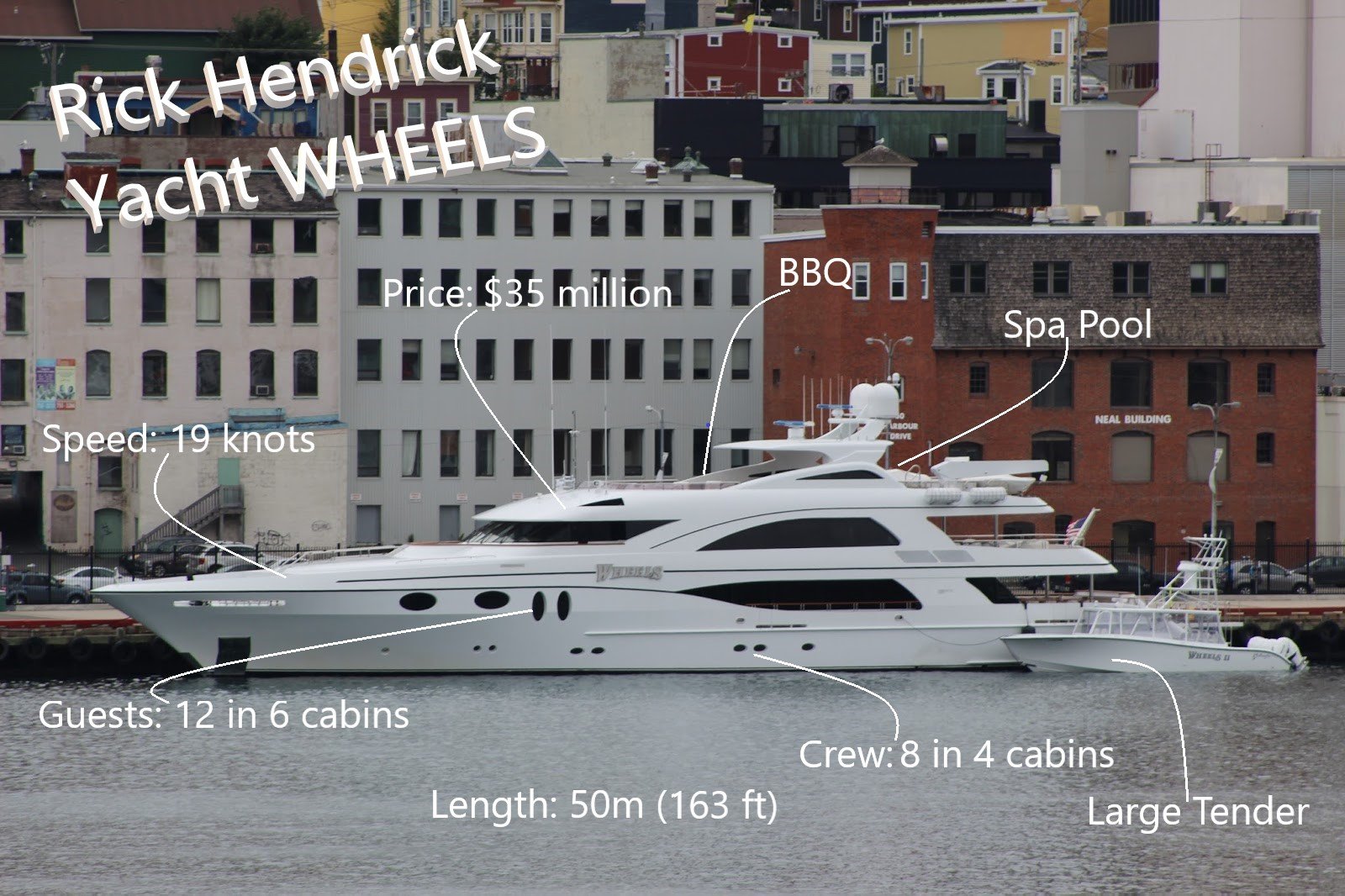
Rick Hendrick Yacht WHEELS

SuperYachtFan Yacht Owners Database Q3-26